
The Limits of Power: When Legitimacy Erodes


Institutions do not become unstable only when they lose power; more often, instability emerges when power remains but the basis on which it is accepted begins to weaken, even as governments exercise authority through institutional structures, corporations command vast economic resources, and executives hold formal decision-making authority within complex organisations. These instruments enable authority to be exercised, yet they do not by themselves secure its durability. Institutions remain stable only to the extent that their authority continues to be recognised as appropriate within the social order in which they operate.
This recognition, commonly described as legitimacy, exists where authority aligns with the rules, expectations, and standards by which societies interpret institutions and evaluate those who govern them. Where such alignment exists, the exercise of power rarely requires constant enforcement, because decisions are accepted within a framework that makes authority appear justified. When this alignment weakens, however, the cost of exercising authority rises, and institutions increasingly rely on persuasion, control, or coercive capacity to maintain positions that once rested largely on recognition. The erosion of legitimacy rarely occurs through a single visible rupture; it develops instead as a gradual misalignment between institutional authority and the expectations that sustain it, and institutions rarely lose legitimacy because they abandon rules altogether, but because adherence to rules begins to substitute for judgment.
In political systems, this can take the form of declining confidence in the narratives that justify authority, even while administrative and coercive capacities remain intact, as illustrated by the collapse of the Soviet Union, where institutional structures persisted long after the credibility of the governing model had begun to weaken. A similar pattern can emerge within economic institutions, although it operates through different mechanisms, as organisations whose authority rests on technical competence and professional responsibility may experience legitimacy erosion when internal priorities shift away from the standards that originally sustained trust. The crisis surrounding Boeing’s 737 MAX reflects such a process, where decisions shaped by financial and organisational pressures gradually altered the framework within which professional judgment was exercised, ultimately exposing a misalignment between institutional authority and the expectations attached to it, even though formal regulatory requirements continued to be met.
These patterns point to a broader institutional condition. Legitimacy does not rest on legal authority alone, but is sustained through several forms of recognition at once: compliance with legal rules, the ability to deliver value to those affected, alignment with ethical expectations, and consistency with what people believe institutions are meant to be.
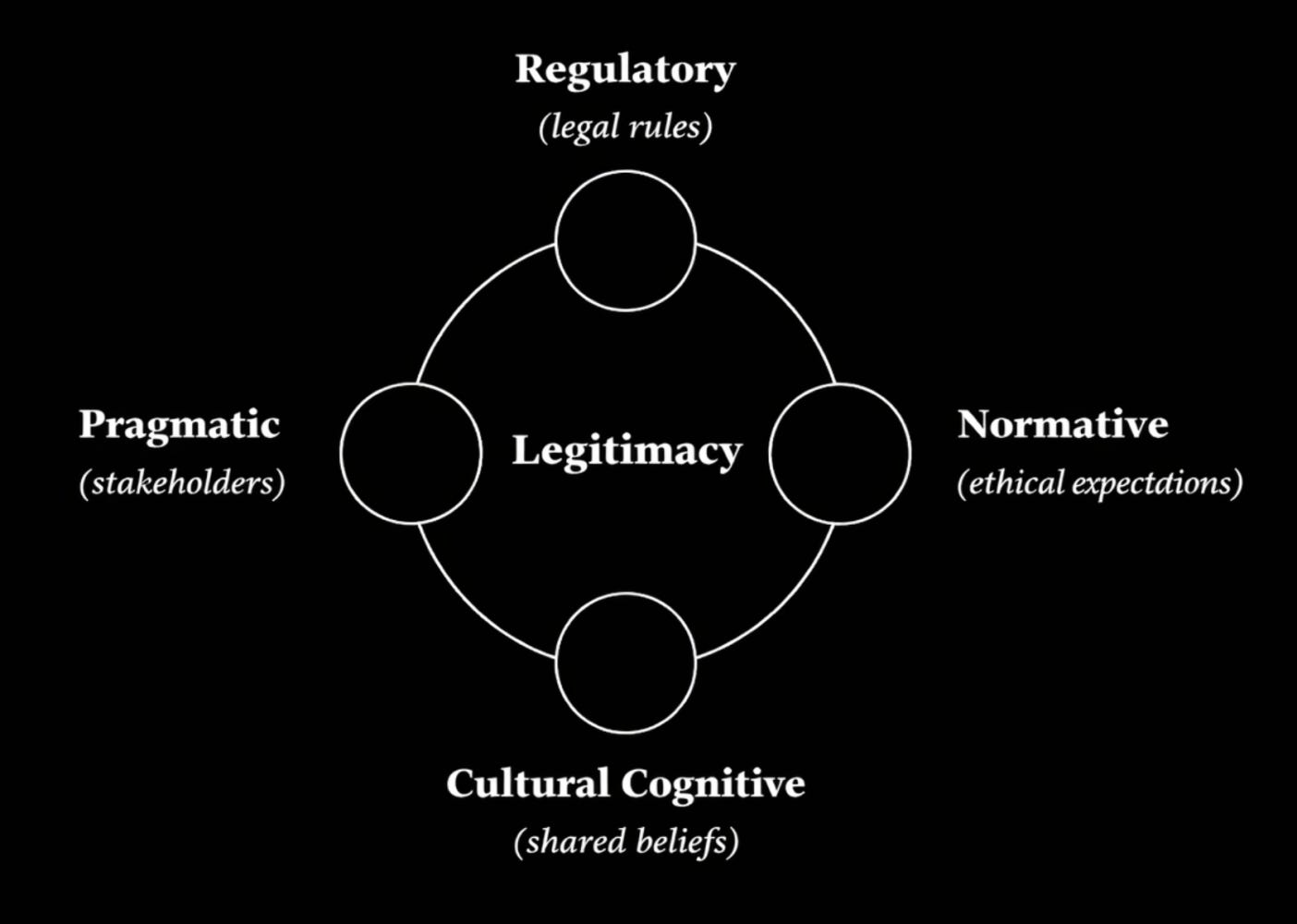
When these elements reinforce one another, institutions appear stable because their authority fits naturally within the social order. When they begin to diverge, stability weakens even if formal authority remains intact, and this divergence often develops gradually and remains difficult to detect until institutional crises make it visible. Organisations may retain legal authority, organisational capacity, and technical expertise while the recognition that sustains their authority slowly deteriorates, so that by the time instability becomes apparent, the legitimacy deficit has often been accumulating for years.
Authority rarely collapses because power disappears. It collapses when the justification that sustains it no longer aligns with the expectations through which it is judged.